The familiar UTMB arch in Chamonix marks the start of a much less familiar event each August. While thousands focus on UTMB, CCC, OCC and TDS, small teams set out on an unmarked journey covering around 300km with 25,000m of ascent for PTL; the UTMB race you didn’t know existed.
This is La Petite Trotte à Léon, or PTL. Despite a name translating as “The Little Walk of Léon”, it’s the longest and most technical challenge at UTMB Mont-Blanc.
The route changes annually and passes through France, Italy and Switzerland. Teams of two or three navigate using a GPX file and roadbook released only a week earlier. They encounter high-altitude paths, off-trail ground, glaciers, via ferrata and exposed scrambling. There are no course markings and no official ranking.
Applicants must submit evidence of sufficient mountain experience. In 2026, teams had 151 hours to complete the course. Antonio Codina’s extraordinary race report tells the story of his team; read it and then listen to our podcast with him this Friday.
La PTL 2026 – The Geordie Joggers strike again!
What is la PTL and why we came back
La PTL is the hardest and more technical race of the UTMB lot, and you may not have even heard of it. The name is a joke, the Little Walk of Leon. But there is nothing small about it. The route accumulates 300km and 25,000m of elevation, and it includes technical passages that require the use of via ferrata gear or Mini crampons.
The idea of a route that was more technical and longer than UTMB came out 5 years after the first edition of UTMB, and it was named after Leon, a baker of Champex-Lac and one of the original volunteers of the race. The event has been organised ever since, as a fringe race among all the events of the UTMB world series that are much bigger in participants and much better known.
The race is done on teams of 2 or 3, and to be selected you must send a form listing the experience of each member of the team. The route changes every year, and the GPX file and roadbook are only disclosed the week before the race. A committee of mountain guides from France, Italy and Switzerland select the route a year in advance. This is not an easy feat because of the constantly changing landscape of the Alps and because we cross many protected areas. To add even more unique facts, la PTL is non-competitive. At the end of the race there is no top 3 podium, running stones or UTMB index, all finishers come on stage, get a cowbell and ring it until we all go deaf.

Why the Geordie Joggers Returned for La PTL 2026
The Geordie Joggers is a team made up of Rob Brooks, Jon Heaney and myself, Antonio Codina. Only Rob is a born and bred Geordie, Jon and I just live here in the North East of England but that is the name we go for. We first did the race in 2025, and you can find the story about it in my blog. We had an amazing adventure, and even if we had a few interesting problems, we completed the loop back to Chamonix. The weather was terrible though, the storms affected the area from the third day and we missed a lot of the high ground of the route planned for that year.
It sort of felt as if we were missing something, and a week after returning home I got a message from Jon and Rob: “we want to come back next year, but it has to be the original team, what do you think?”, obviously, I could not say no.
La PTL 2026: Chamonix to Fully – 83km and 7,456m
Starting La PTL 2026 in Chamonix
And that is how one year later we found ourselves again in Chamonix, in front of the UTMB arch, listening to the tune of The Last of the Mohicans. I am not embarrassed to say that I had tears running down my face listening to the song and the countdown. Being at the start line after all the months of training and preparation, avoiding injuries and family issues, meant so much for me. Probably even more when you have already done the race and you know what it’s going to be like.
We stormed through the streets of Chamonix and I couldn’t believe my eyes when I spotted Sarah Perry among the crowd, and I had to stop for a very quick hug. A bit later on, Kilian Jornet and Emily Frosberg were also out with their kids cheering us. We started on a flattish section this year, to warm up before an incredibly long climb to the Glacier de Tour. The spirits were high, the sun was shining and we were saying hello to friends from last year, both runners and volunteers. Similar to the family spirit of the Spine race in the UK, La PTL has formed a family of volunteers and runners that return every year for another lap of 300km and 25,000m of elevation in the massif of Mt Blanc.

We crossed the glacier following the flags that avoided the crevasses, and we were giggling like children at the immense fun that is trotting along the ice on our mini crampons. After a brief stop at the Albert 1er hut, the last stop of last year and witness of a near race ending experience, we climbed over rocks to reach the next pass. We descended another glacier and entered a huge boulder field. The fast melt that the glaciers of the Alps are experiencing in the last years are leaving many areas of unstable boulders and scree, and we just had to navigate carefully the rock labyrinth. Loaded with about 8kg of food, clothes and via Ferrata gear, the boulders were energy sapping, but from the start of the descent, something was not right with Rob. He was struggling to descend the boulder field, feeling a bit lightheaded and unstable, and falling a few times.
Crossing Glaciers and Navigating the Boulder Fields
In a race like this I am a bit of a worrier, and I started to calculate in my head that at this pace we were going to struggle to finish the race. Rob started to feel better when we descended a bit and the terrain was easier, and we arrived at the first base of Collonges, where we had planned to sleep for 1 hour, well before the cutoff time.
The rain started about 1 hour before we arrived at the sports hall, and the trails were still in good condition, but they turned into muddy soup while we were resting. Teams of runners kept arriving completely soaked and covered in mud. Although we left our shoes at the entrance the floors were wet and dirty and it was impossible to dry or keep your feet dry. We were out around 6am, when it was still raining. There was a climb of 3000m ahead of us, and what a climb it was, up the beautiful Dent de Morcles.
We knew the weather was going to improve, and as we climbed the clouds parted and we started to get deep in the rock walls that form la Dent de Morcles. It was technical at times, with big drops to the sides of the barely existing trail, a truly amazing climb and even better summit, with views that went on forever. From there we traversed the rocky landscape to get to the magnificent Cabanne de Fenestral. We had to use fixed ropes to get there, and we worked with a French team to find the best way across the boulders. We had a dehydrated meal at the hut and from there we climbed the summit of the Grand Chavalard.

The Dent de Morcles and Grand Chavalard
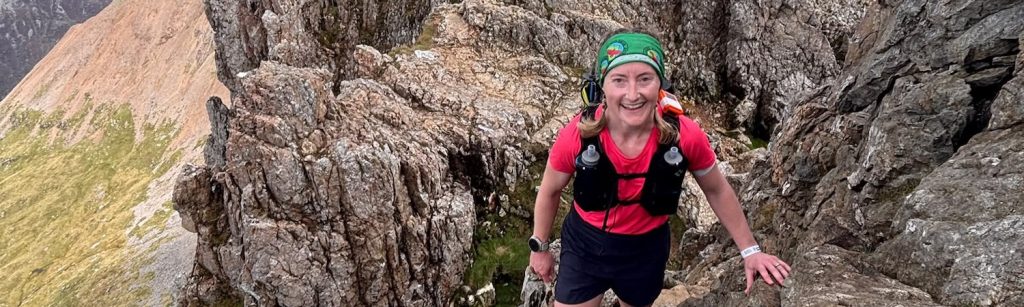
The climb to the Grand Chavalard is a scramble with grade 3 sections, no fixed ropes or cables. Some sections were so exposed that I had to double check that we were still on the route. Absolutely magic. To finish this section, we had to descend really steep all the way to Fully in the valley, where we were going to get our drop bag for the first time, and 3 hours of sleep. That was one of those descents of the Alps that seem to go on forever and we were absolutely broken when we reached the checkpoint.
Rob was especially happy to get to his drop bag, because sometime during the first night the upper of his right shoe split open, to the point that his toes were outside the shoe! How he managed to complete the two monster climbs of the second day is something that me and Jon struggle to comprehend. But we made it, and I can say for certain that this second day is one of the best mountain days I have had in my life.
La PTL 2026: Fully to St Rhémy – 123km and 9,920m
Through the Night from Fully to Fionnay
We had arrived at the checkpoint of Fully when it was still light, and we left around 10pm, after having some food and trying to sleep for a couple of hours. Our plan was to go through the night in what should be a relatively easy section. We passed through Verbier, climbing high and eventually getting to an entertaining ridge. In this section we met some friends, the Team BS boys of Ian Hoare, that we kept meeting from time to time. I have been really good friends with Ian since we finished UTS100M together, and with that the friendship extended to our full two teams. Ian at that point was having a bit of a wobble finding the way across some boulders, which I admit it was not easy in the dark. But nobody is left behind in the PTL. We crossed the section together and made good progress across the rocks. That is what the PTL is about, a big team of runners helping each other as we move through the mountains.
The route kept us entertained, climbing and descending between 2000 and 2500m of altitude, but it was easier ground than the day before. 35 km and 3500m of climbing after Fully, we were glad to find our first stop on this section at the Cabane de Monfort, a really nice mountain hut where we had a three course meal, and from there we moved quite easily down to the next stop of Fionnay. At this point it was early afternoon but it was the best place to catch some sleep before the next section. As we had eaten not so long ago, we chose to sleep first, and then have food.

Sleep Deprivation and Life on the PTL
Talking about sleep, this was the most difficult part to work out as a team and the one that we struggled to agree at times. On a race like this my brain is working all the time, so I can only sleep 2.5 hours before I wake up and start thinking about the next section, the things to prepare for it and so on. Jon and Rob could sleep 4 hours no problem, or just lay down for that time, because they would complain that they didn’t sleep very well because it was too noisy or hot. I just think there is no point in wasting time in a busy dorm if it’s too busy and you cannot sleep, but my team mates worked better with longer breaks.
We also had different cycles of energy, with me flagging more in the afternoon, Rob struggling more at night, and Jon being generally useless (his words) in the morning or after a sleep. That means that generally there is always someone that is going through a bad patch. You can only move as fast as the slowest of the team, and going as a team for several days definitely tested my little patience in many ways. This year I felt I was the stronger of the three, probably because it was a more technical route than last year and that suits me more, so I was doing more worrying and waiting, quite often looking at the cutoff times.
Learning from our mistakes from last year, before going to bed we always agreed at what time we had to be up and what time we wanted to be back on the trail. But the mountain huts that we were using were quite small, and at times we were literally dragged out of bed by the volunteers after 1 hour or so because they had several runners waiting to sleep a bit. In this case we all had between 2.5 and 3 hours of sleep, that we would have to top up at one point with a trail nap.
Our next stop after Fionnay was the refuge the Chanrion, a hut at more than 2400m that sits at the intersection of the tour de Mont Blanc and the Chamonix – Zermatt routes. To get there we followed the valley along the huge reservoir of Mauvasin, with the Grand Combin, one of the most beautiful mountains of the Alps, to our right.
Going again through the night we could not enjoy the views, but we had a full moon that allowed us to see and feel the magnitude of the landscape around us. We were happy to cover this section in the dark, because after the refuge of Chanrion we had a large via ferrata section that we would cover in daylight. We had food and a quick reset at Chanrion, but we didn’t wait for a space to sleep and we went out into the night. Just before the large climb to the start of the via ferrata we had a good trail nap to be fresh and ready.

Trail Naps: Learning to Sleep in the Mountains
We had learnt now all about trail naps and we had a good technique for it. Laying the poncho on the floor to remove humidity, wearing all our clothes to try to stay warm, and setting an alarm on our phones. Slowly we were getting used to the new life in the PTL, where trail naps of 1 hour would keep us going for 5 hours or until the next hut. I always find it amazing how our bodies can adapt to new situations. I often find in these events that by the third day you get used to the weight of the backpack, the lack of sleep and the new cycle of sleep / fuel / hike and if you put enough fuel, you would actually get stronger as you go.
Back to our trail, with the first light and the most amazing views all around us we reached the ridge of Crete Seche, and the via ferrata that would take us 2 hours to cross. I was first on it, with Rob and Jon following behind, and when I reached a safe spot, I had enough time to take pictures of them. The light, the ridge and all the mountains around us offered the most spectacular images that I will never forget.
The Hardest Night of the Race
What followed was one of the hardest times of the full race. We climbed over the col du Mont Gele, and on the other side we found a huge boulder field that took us hours to descend. Although we were following the trace on our watches, our sleep deprived brains could not work out the best route across the huge blocks of rocks. We would find ourselves in dead ends impossible to cross and had to retrace our steps. Rob was by this point struggling quite a bit, and we had to wait for him a bit. At times he was so exhausted that he would lie for 5 minutes to sleep. His feet were also in a really bad state making him advance much slower than Jon and me. I was very worried about the full situation, we were slowly wasting time and getting closer to the cutoffs. But on the other hand, there was nothing we could do about it because even if Rob had considered dropping out of the race there was no chance of him doing it until the next large base of St Rhemy, with good transport links and a chance of getting back to Chamonix.

The route kept giving us more gifts in the form of incredibly long and hard climbs. Slowly we found ourselves climbing the col de By. An incredibly steep grassy ridge that took us to 3300m high. Rob was really struggling and Jon stayed behind him to encourage him, but he really was on a bad way. When we reached the top though, the most formidable view appeared like a mirage between the clouds. The Tete Blanche de By and Glacier du Mont Durand.
More PTL Trail Naps
We all needed a bit of a rest and we were very happy to stop at the Refuge de Amianthe a few minutes later. We had some pasta and 1 hour sleep, and we resumed our descent to the refugio de Champillon in the Aosta valley, one of the many huts that you cross in the Tor de Geants route. Apart from an argument with some cows, the descent was quite simple, and we could enjoy the beautiful polenta and tiramisu served by the fantastic volunteers. There was a waiting list for sleeping, and as the weather looked dry for most of the night, we decided to press on and catch some sleep later on the trail.
We slept one hour in a clear of the forest, and we pressed on through the night towards St Rhemy, where we would be reunited with our drop bags again. It started raining at one point during the night, and the ponchos and raincoats had to come out. The highest point before descending to St Rhemy was the Tete de Barasson, and we got there when it was raining most.
When we arrived at the pass below the summit, we found a Chinese and a French team there trying to warm up behind a rock shelter. The Chinese guys (Team Add Oil) looked very cold but they told us they were ok. The French guys (Team Vitamin D+) went for the summit as the wind was getting stronger and came back saying it was terrible at the top and they could not see the way down from the ridge. We rang the safety team, who told us in a few French words to “man up” because it was very easy to come down from there, and they had not activated the bad weather route yet. If we were worried the best was to go all together. At that moment the BS boys also appeared and we all joined forces to move the 4 teams to the summit, and me and BS boy Jake Hayes took the lead to find the way down from the ridge. The weather improved a bit and we could see better, and in no time we were all on safer ground on our descent to St Rhemy and our drop bags.

Leaving Rob Behind at St Rhémy
While all this was unfolding Rob’s feet seemed to degrade to a new level, with huge blisters that covered the ball and big toes of his feet. The descent to St Rhemy was therefore really slow and when we arrived, he asked the opinion of the medics. He told us later that on this last descent he knew his race was over. He probably wanted to have a second opinion but it was really obvious that it was not possible to continue with his feet in that state. It was sad to leave Rob behind, but also a relief because he was suffering quite a lot and it was just a matter of time before the full team was going to DNF if we continued at his pace. The next section was 42km long, with several high altitude passes and me and Jon were sure that Rob was in no state to complete it before the cutoff. So, we hugged Rob goodbye, and while he sorted his lift back to Chamonix, we slept a couple of hours and got ready to go.
La PTL 2026: St Rhémy to Chamonix – 88km and 6,809m
Bad Weather Changes the Final Section
We didn’t have a lot of time over the cutoff and we were keen to make some ground. Our next landmark was the stunning Col de Malatra, a very well known feature of the Tor des Geants. It was still raining and it was windy at the tops, so the bad weather had been activated after the pass.
That means that we missed a via ferrata section and we were both glad of it, because we would have done it at night with bad weather or wet rock. The bad weather route took us down to the Tour de Mont Blanc trail, which we followed for a few miles. The clouds had parted, and a huge full moon raised illuminating the massif of Mt Blanc. In the middle of the night the mountains revealed in front of our eyes with all the icefields reflecting the moonlight. It was just stunning.
On the climb to the col Ferret, we left the trail and moved through rough ground until hitting a ridge. We then followed that line that kept giving us views over the moonlit mountains for several miles, until reaching the col ferret again and heading down towards La Fully. Jon thought there was a checkpoint here where we could sleep, and I wanted to believe it as well, but when we realised that we still had 7km left we had a bit of a meltdown. We were just very very tired, so we dozed for 30min or so leaning against a rock by the road, and then set off to find our stop for the day, the hut of Saleinaz.

Storm-Damaged Trails and Another Race Against the Cutoff
We were following the tour de Mt Blanc trail on and off, and on the last section we crossed several signs saying that the trail was closed ahead. As our route was going that way we assumed it would be ok, but we found a trail nearly destroyed by a storm, with trees and large boulders blocking our way. We worked with another French team and managed to find the way through, but several teams turned around and found their own way along the road, wasting a lot of time and energy when we had already done 42km and 3000m since leaving St Rhemy.
Before going to bed, we were told that the bad weather route was active for the next section too, and we would miss the last via ferrata of the race. That meant that even if the distance and elevation were going to be the same, progress would be relatively easier and faster. I woke up after 2.5 hours to find that the route assessors had concluded that it was OK to come back to the original route, so I dragged Jon out of bed because we were going to have another epic day in the mountains.

The Final Via Ferrata of La PTL
Straight from the hut we climbed and climbed to the col de Breya, descended to the other side and climbed to the col des Ecandies. It was the middle of the afternoon by this point, and we were climbing higher and higher, first on trails and then over huge boulders, until we reached the col and we had the most immense view over the Glacier du Trient.
The descent to the glacier was done clipped to a via ferrata, and the rock face was extremely dirty with loose rock. It was a delicate descent and traverse with a couple of guides helping to clear the route and adding fixed ropes to make it safer. I can just say I was glad that we did it with daylight, because both the descent and the boulder field that followed were really tricky to navigate.
We just had one more climb to the col du Balme, to get to the hut of Charamillon, the last rest place before the push to the finish line in Chamonix. Jon mentioned sleeping 4 hours before doing the last section and I nearly had a heart attack. “Can we not have a quick nap and just get on with it?” is more or less what I said. Jon seems to love spending hours in a dormitory surrounded by snoring men.
When we arrived at the hut, to my delight we were only allowed to spend 2.5 hours in total there, and the sleeping quarters were some tents outside that were absolutely freezing. So, after food and 1 hour of sleep we got ready and set off in the middle of the night. We descended down to Tour, but instead of heading back to Chamonix along the valley we had to climb 700m and descend them back. It was clear that not even the final miles of the race were going to be easy.

The Final Push to Chamonix
We were strong during the climb, even passing a couple of teams, but the descent took us a long time. We were both getting tired, and we even had collective hallucinations, with both of us seeing owls and birds of prey perched on the trunk of a tree that were obviously not there.
But we finally reached the valley floor, and made the long run back to the UTMB arch. It was 8am and we didn’t have the crowds of last year to welcome us, but Rob was there, and my friends Cajsa and Leo were there too. And we crossed the finish line and hugged each other. It took us 144 hours, or 6 amazing days, to finish La PTL.
All photos courtesy Antonio Codina. Read about his adventures here